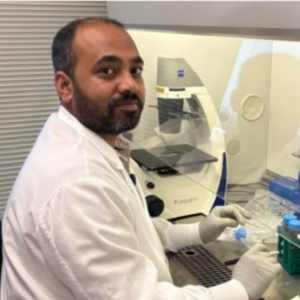
Dr. Nagesha G. Kondegowda & T1D
Type 1 diabetes (T1D) is an autoimmune disease in which the body's immune system mistakenly attacks and destroys the insulin-producing beta cells in the pancreas. These cells are responsible for sensing blood glucose levels and releasing insulin, the hormone that allows glucose from the food we eat to enter our cells and be used for energy.
A diagnosis of T1D is life changing. As the disease progresses, beta cells are gradually destroyed until the body can no longer produce enough insulin to survive. The only treatment for T1D is external insulin. People with T1D need to be hypervigilant- measuring their blood glucose levels many times a day and administering the correct dosage of insulin many times a day. This is extremely taxing, and if insulin is not administered in time, the consequences can be fatal. While treatment exists, people with T1D deserve a cure.
Here at Diabetes Research Connection, our mission is to progress research towards a T1D cure by funding early-career, innovative, out-of-the-box approaches.
A New Focus: Combination Drug Therapy
That’s why DRC-Funded researcher Dr. Nagesha Guthalu Kondegowda is focused on discovering a therapy approach to prevent beta cell dysfunction, beta cell death, and even promote beta cell proliferation. His project looks at a combination of drugs that are either FDA approved for other disease processes, currently in clinical trials, or have already shown to be safe in humans. Rather than focusing on one drug at a time, this project asks whether combining several drugs at once could prove to be not just additive, but synergistic, to beta cell survival and recovery after injury.
Although many drugs show promise in the laboratory setting, they may still end up being deemed unsafe in human trials. A major advantage to Dr. Kondegowda’s approach is that by focusing his T1D cure efforts on drugs that have already been proven to be safe in humans. Thus, Dr. Kondegowda is ensuring that, if his hypothesis that a multi-target approach can help beta cells survive highly inflammatory conditions and damage is correct, the results can be translated into studies in humans faster than beginning a new drug target that needs full safety validation.
Promising Results So Far
Currently halfway through this DRC-funded project, Dr. Kondegowda has tested his drug combinations on human beta cells grown in the laboratory from donated pancreatic tissue that would otherwise have been discarded after surgery. He found that treatment of human beta cells using one of the combinations increased the proliferation, or the growth and division, of beta cells by seven-fold more than each drug alone, or no drug at all. These results support his initial hypothesis that combining several drugs that have different targets will have synergistic effects.
Why This Research Matters
His next steps are to test his drug combinations in a mouse model of T1D. His hypothesis is that the drug combinations will prevent T1D onset in the mice. If he gets his anticipated results, this would be extremely promising to move the drug combination into clinical trials. The potential impact of Dr. Kondegowda’s work is a new, multi-target drug approach to slow down, and potentially reverse, T1D progression.
How DRC Donors Make It Possible
Innovative projects from early-career scientists, like Dr. Kondegowda, often struggle to secure traditional funding. Yet it’s these early investigations that spark pathways for new treatments.
Thanks to donor support, DRC provides researchers with the essential funding to pursue these game-changing ideas from day one.
How You Can Help:
- Donate to DRC to support this research and other high-potential projects
- Subscribe to our newsletter for updates on this and other research breakthroughs
- Dive deeper into this innovative project and learn more about Dr. Kondegowda
Together, we can accelerate the research that will lead to better treatments and, ultimately, a future free from the constant burden, fear, and complications of type 1 diabetes.