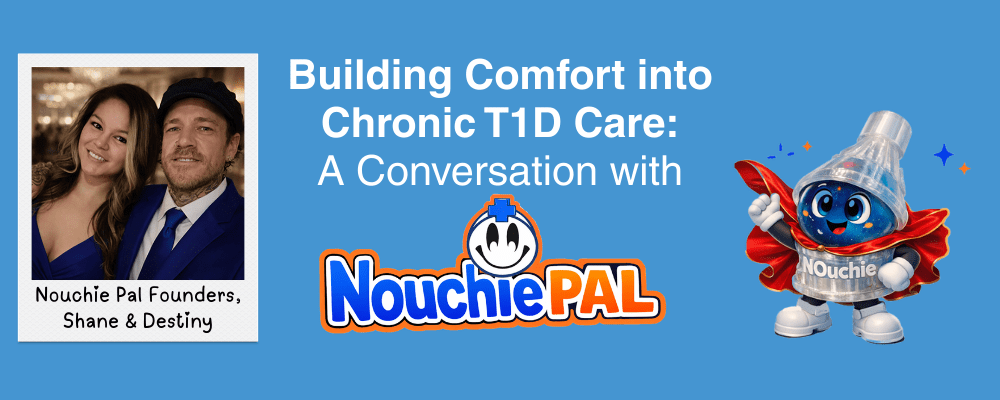
Before his Type 1 diabetes diagnosis at 40, Nouchie Pal co-founder, Shane Hibbetts’ life was defined by movement, i.e., dirt bikes, extreme sports, and eventually rebuilding strength after a broken back. But a sudden hospitalization at the age of 40 in diabetic ketoacidosis during COVID changed everything. Alone in the hospital and now responsible for managing insulin, timing, and constant monitoring, everything about daily life shifted.
What began as a personal attempt to make injections feel less disruptive eventually evolved into Nouchie Pal™, a reusable, drug-free cooling tool designed to make injection moments more manageable. In this conversation, he reflects on diagnosis, emotional fatigue, and why comfort deserves a place in chronic illness care.
Give us a quick intro to you! Who are you and what was your life like before diagnosis?
I grew up chasing adrenaline — dirt bikes, extreme sports, always outside, always moving. I come from a construction family, and toughness was just part of the culture.
Right out of high school, I broke my back. I had to relearn how to walk, talk, and regain motor function. Most people would have slowed down. I didn’t. I just adapted. When my physical limits changed, I taught myself how to paint. Art became another form of movement for me.
I’ve always believed you adjust and keep going.
Can you take me back to the moment of diagnosis: what changed overnight for you? How did the shift from outdoor adventure to managing daily injections affect you physically and emotionally?
Then at 40, everything changed again.
One day I was riding my dirt bike in the desert. The next, I woke up in the hospital in diabetic ketoacidosis during COVID. No visitors. No family allowed in. Just me and a diagnosis I never saw coming.
I was covered in tattoos — head to toe — and still wouldn’t let the nurses near me with a needle. It’s one thing to sit for a tattoo you choose. It’s another to inject yourself multiple times a day because your life depends on it.
Learning the math, the timing, the constant monitoring — it was overwhelming. I thought I knew what tough was. This humbled me.
You’ve talked about the disruption and pain of injections as an adult, despite having lots of tattoos. Did that experience make you think differently about families who are navigating this from infancy?
As I became part of the T1D and chronic illness community, I met families navigating this from infancy.
Parents doing midnight checks.
Kids learning carb ratios before multiplication tables.
I already respected resilience. But this gave it a whole new meaning.
If I struggled at 40 — how does a five-year-old process this?
That question stayed with me.
What was the hardest part about injections that people without T1D might not understand?
What people don’t see about injections isn’t just the physical sensation.
It’s the interruption. The mental calculation. The constant reminder.
Even when you’re “used to it,” there’s a layer of emotional fatigue. Every injection is a pause. A negotiation. A reminder that this isn’t optional.
That weight builds.
When did Nouchie Pal shift from a personal workaround to a real product?
Nouchie Pal started as something personal. I was just trying to make injections less disruptive — less sharp, less mentally draining.
When I realized how much it helped me, I couldn’t ignore it.
You mention four years of research and testing: what did that process involve?
I began refining it obsessively — materials, ergonomics, coatings, temperature control. What started as a workaround turned into four years of testing and redesigning until it felt right.
Not just functional. Comforting.


Do you think comfort tools like Nouchie Pal change how someone emotionally relates to their diagnosis?
Comfort tools don’t cure T1D. But they change the experience.
I’ve watched a young child bridge the gap between food and injections without fear. I’ve seen a mom tear up because her son didn’t cry after his injection that night.
And I’ve felt my own quality of life improve.
When something softens even a small part of daily management, it matters.
Chronic care shouldn’t feel harsh if it doesn’t have to.
What changes would you most like to see in T1D treatment over the next decade?
Over the next decade, I hope we see care that’s more accessible — to everyone who needs it. And of course, a cure that’s accessible to everyone.
Until then, I believe comfort, dignity, and thoughtful design belong in daily care.
Because shots shouldn’t hurt more than they have to.
Type 1 diabetes demands both innovation and endurance. While researchers work toward better treatments and ultimately a cure, people living with T1D continue navigating the daily realities of injections and constant decision-making.
Stories like this remind us that progress happens on multiple levels. Scientific breakthroughs are essential. So is improving the quality of life right now.
If this conversation resonated with you, here are a few ways to stay connected and support the broader T1D community:
Learn more about Nouchie Pal™ and, if it feels right for your family, use code DRCFAM for 10% off.
Make a contribution to help fund innovative, early-career scientists working toward life-changing Type 1 diabetes breakthroughs through Diabetes Research Connection.
Sign up for our newsletter for more community stories, upcoming events, and research updates.